Phone Texting: (727) 834-0438
2803 Troy Road
Springfield Ohio 45504
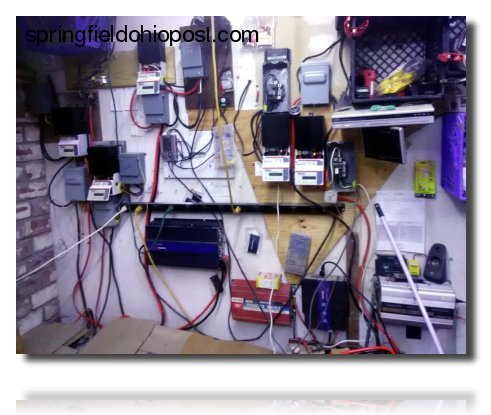
With a dizzying array of resolutions and features to choose from, invariably some of the best cameras will have undesirable higher voltage requisites.
If using a 12v battery bank, this means a step-up converter of some sort, that must be incorporated.
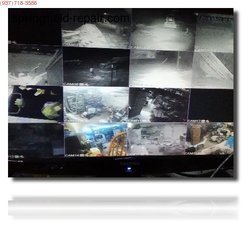
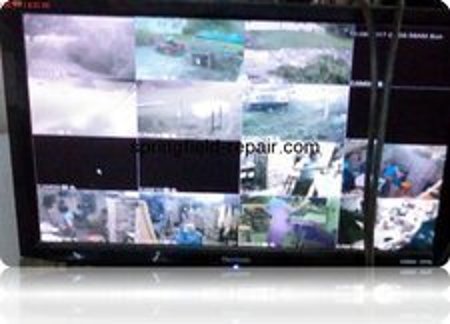
Other features such as PTZ, allowing a user to PAN, TILT, and ZOOM (mechanically zooming in or out with either a joystick or a mouse), can require additional wiring.
No matter what type or quality camera available, anything is better than nothing.
Some of the benefits of cameras are the ability for some semblance of omniscience.
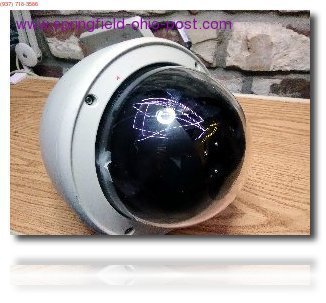
The PTZ camera shown is one of three here presently. The housing is all-steel constructed (as opposed to plastic). The unit has a thick tempered glass dome (that apparently is not easily breakable).
The unit runs on plates as opposed to being restricted with wires, and can spin incessantly in one or the other direction (whereas the cheaper units can only go so far, then must turn back due to being wire-constructed.
The unit also allows for 27x mechanical zoom (and an undefined software zoom resolution). A mechanical zoom is the preferred method when using these types of cameras as the software zoom results in depreciation of picture quality.
Night-vision cameras, indicative of the IR's (infra-red) which surround the actual lens, can be advantageous in low-light areas.
Not all cameras allow the ability to manually focus on a particular point. In fact, most consumer-based cameras are pre-set at the factory of origin and not easily manipulated to deviate from the manufacturer's settings.
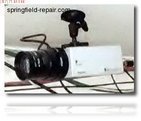
Focusing and zooming to a spot, such as on a wall, allows for the increased fine-tuning of the alarm or other functions, when the field is tripped.

The cameras are also great for zooming to a point in the driveway where all that can be seen are stones and concrete, until an automobile arrives, then it's 32 frames of a license plate!

A downside to larger DVR's are that cameras, ptz-wiring, microphones, create a mess of wires.
Shown is the backside of a DVR unit that will handle 24 cameras and 16 microphones.

Although Wireless is an option, unfortunately wireless is not under all conditions to be a great option.
Picture quality, reliable of picture, operate without flaw when hard-wired.
Most wireless cameras operate at either 900Mhz or 2.4Ghz frequencies (and nowadays 5Ghz), so there's a number of ways to jam the signals that would render a security system useless.
There are other less nefarious means to compromise a security system using just a common cellular phone!
But there's another downside to choosing wireless over wired cameras, that being what I refer to as "the crazy mouse syndrome".
Actually a couple of incidents that make for a humorous story behind this crazy mouse syndrome could be told, the short version of the story is that you will swear your laptop is needing an exorcist whenever near the wireless cameras.

Today's Date is Sunday, 20-Sep-2026 21:26:14 EDT
2014-2026 Kenny Hendrick and the Public Diary. All Rights Reserved.
Did you find anything helpful?
The Link below may be used to pay for merchandise,
Computer Repair Services,
or to buy me a coffee!~